
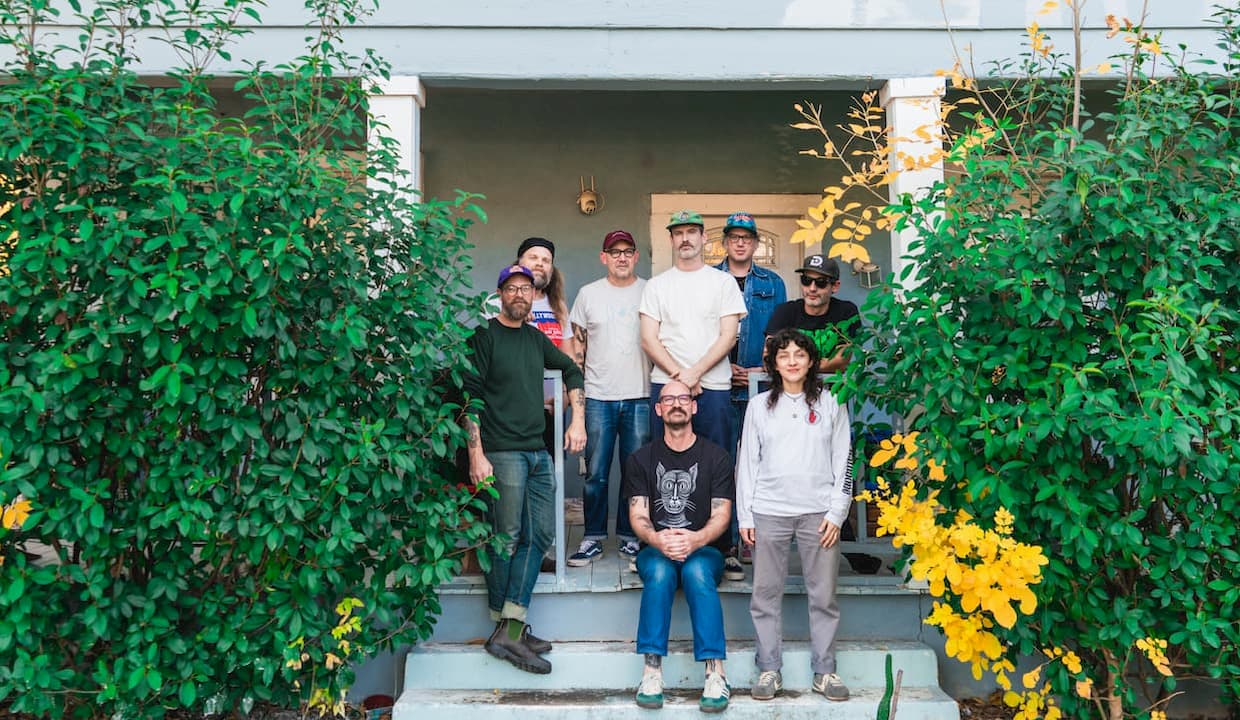
On Friday, November 6, Water Damage, the loudly droning collective from Austin, will take over the AB Club.
Under the motto “Maximal Repetition Minimal Deviation”, Water Damage creates immersive, fluid waves of drones. The members are all veterans of various projects—including Spray Paint, Black Eyes, USA/Mexico, more eaze, Thor & Friends, Marriage, Swans, SUR, and Astral Spirits Records. Their approach to the form is less frontal than that of many of their contemporaries, with the surface of their sound occasionally disrupted by auditory events that are anything but drone-like. Yet at its core, the main body remains a mix of harmonic tones and textures pointing toward a destination just beyond earshot, right over the next hill, and perhaps forever just out of reach.
But what exactly is drone music, and why are these live concerts such a unique experience?
Drone is a genre where everything revolves around slowing down, deepening, and listening with your entire body. The concept of the drone or bourdon — a single, constant, sustained tone around which an entire piece is constructed — is ancient. You can find it in the hypnotic sounds of the Indian tanpura, medieval bagpipes, or ritual Gregorian chants.
In the middle of the last century, experimental avant-garde masters like La Monte Young, Éliane Radigue, and Tony Conrad tore down the traditional laws of Western music. Instead of writing narrative arcs, melodies, and tight rhythms, they shifted the spotlight onto pure microtonality, harmonic overtones, and the raw impact of the extended tone.
Today, the influence of drone resonates across a wide spectrum. From the layered, dreamy ambient of Brian Eno and Stars of the Lid to the crushing, heavy-as-lead guitar walls of Sunn O))) or the digital sound architectures of Tim Hecker: all these artists use the sustained sound as their ultimate weapon to break open the way we experience music.
An intense, shared immersion
What makes a live drone concert so extraordinary is the raw, physical group experience. As the room fills with heavy frequencies and sustained sound layers, the space transforms into a monolithic wall of sound. It doesn't just resonate in your ears, but vibrates directly through your chest and beneath the floorboards. The venue itself becomes an instrument: depending on where you stand, the acoustics shift, revealing new harmonic details.
Whether the music is abrasive and whisper-quiet or downright massive and overwhelming: the audience undergoes the exact same physical wave of sound. Free from the distraction of driving beats or traditional stage shows, a rare, almost sacred focus emerges.
A concert you don't just listen to, but experience together with your entire body.